Salon and beauty shop software, built for how Tanzanian salons actually work
Most salons here are two businesses in one: a service business selling time in a chair, and a retail business selling product off a shelf. Software built only for appointments loses the shelf, and software built only for stock loses the chair. Duka365 handles both in one place, on a phone, in Swahili or English.
What salons keep running into
Relaxers, dyes and creams expire — and you find out when a client complains.
Every product can carry an expiry date, and you set how many days ahead you want warning. Duka365 texts you before stock goes off, so it gets sold or discounted while it is still worth something instead of being written off in a bin.
You cannot tell whether the money came from services or from products.
Services and products are recorded separately and priced separately, so your reports show what the chairs earned and what the shelf earned. That is the number that tells you whether to hire another stylist or widen the retail range.
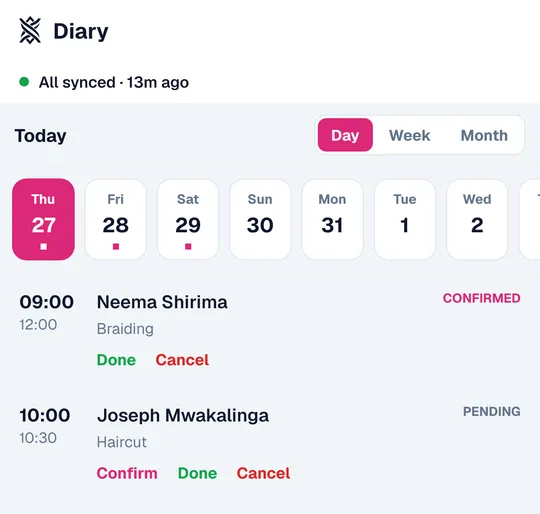
Bookings live in a notebook, and two clients get the same eleven o'clock.
Appointments sit in a shared calendar the whole shop can see. You can also set it so each stylist sees only their own bookings, which is what most owners want once there are more than two chairs.
A regular takes a treatment now and pays on Friday, and by Friday nobody remembers.
Record it as a customer debt against their name. The balance is there next time they walk in, so the conversation is about the hair rather than about whether the money was ever owed.
The same shade in three sizes counts as one product, so the count is always wrong.
Products carry size and shade variants, each counted separately. Your stock take matches the shelf, which means reorder decisions are made on real numbers.
A Saturday, start to finish
- 1
You open the app and see the day's bookings, and which stylist has which client.
- 2
A walk-in buys a relaxer off the shelf. You record the sale; the stock count drops by one.
- 3
A regular has a treatment and pays half. The rest goes on her account under her name.
- 4
A text arrives: three bottles of a shade are below your minimum. You add them to a purchase order for Monday.
- 5
At closing you look at the day: what came from services, what came from products, and what each stylist brought in.
Questions salon owners ask
- Do I need a computer?
- No. Duka365 runs on any phone with a browser, and works on a slow connection. Most salons never open it on anything else.
- Can my stylists use it without seeing everything?
- Yes. Staff accounts see what they need to serve clients and record sales. Profit, costs and reports stay with the owner.
- I sell products and do services. Do I pay twice?
- No. One price covers the whole shop, whether you sell retail, wholesale or both, and you can switch between them whenever you like at no extra cost.
- What does it cost?
- The free plan covers 100 products and 150 sales a month, which is enough for a small salon to run on. Pro is TSh 35,000 a month, and paying for a year gives you three months free.
Start with your shelf
Add your products, record a few sales, and see whether the numbers tell you something you did not already know. It is free, there is no card, and nothing is charged until you decide it is worth paying for.